

Prepared by SAAply · www.saaply.com
FOUNDER CARD
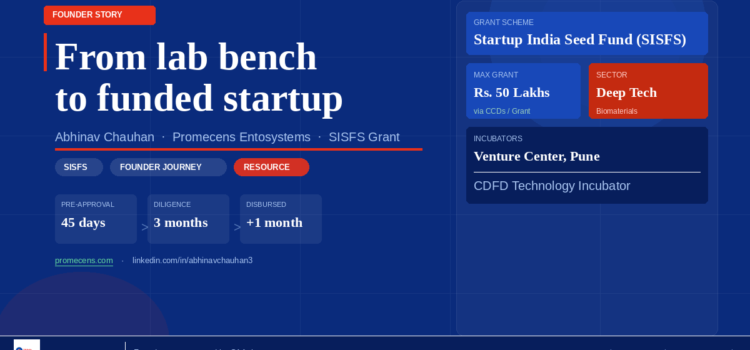
| Name | Abhinav Chauhan |
| Startup | Promecens Entosystems Private Limited |
| Website | promecens.com |
| linkedin.com/in/abhinavchauhan3 |
| Sector | Biomaterials / Deep Tech |
| Grant | SISFS — Startup India Seed Fund Scheme |
| Stage at application | Early-stage validation |
TIMELINE STATS
| 45 days Application to pre-approval | ~3 months Due diligence period | +1 month After approval to disbursement |
The problem they’re solving
Promecens is building advanced biomaterials — high-purity melanin, chitosan, and related bio-based compounds — from sustainable biological sources, targeting healthcare, biomaterials, and deep-tech industries.
Why SISFS?
Abhinav was evaluating multiple schemes simultaneously — including NIDHI SSS and the BIG Grant. SISFS stood out because it supports startups at a critical early stage through a structured incubator ecosystem, not just a cheque. It was particularly valuable because it could support structured progress through an incubator ecosystem rather than just provide funding in isolation.
What the process looked like
The application involved identifying suitable incubators, preparing documents, pitching, and going through due diligence after pre-approval. One often-overlooked aspect: the process isn’t just about filling forms. Founders have to defend why their startup, use case, and proposed milestones deserve support — and be prepared for unexpected technical and business questions under pressure.
How long does SISFS take?
In total, founders should budget 4–5 months from application to receiving funds. Pre-approval took approximately 45 days from application. Due diligence after pre-approval took nearly 3 months. Disbursement followed approximately 1 month after final approval, depending on fund availability at the incubation centre. Founders should not assume approval automatically means immediate disbursement.
Incubator selection — Abhinav’s approach
This is the decision most founders treat as an afterthought. Abhinav treated it as a strategic one. His framework: What facilities do they actually have? How aligned are they technically with your work? And what ongoing support can you leverage post-selection?
For his first choice, he selected Venture Center (EDC, Pune) after direct interaction with the team — strong biomaterials alignment, analytical facilities, and a deep-tech track record. For his second and third choices, he identified CDFD Technology Incubator based on technical alignment with biotech and life sciences, and access to analytical services.
Key insight: Don’t list incubators by reputation alone. The incubator you choose becomes your operational partner during and after diligence — their facilities, team, and responsiveness directly affect your execution.
The Rs.50L vs Rs.30–32L decision
Depending on the incubation centre, approved support may come as a pure grant, as Compulsorily Convertible Debentures (CCDs), or a combination. The structure matters beyond paperwork — it has equity implications.
- Accepting Rs.30–32L: Often a cleaner grant structure, faster to process, fewer equity-dilution concerns.
- Pursuing the full Rs.50L: Higher capital but may involve CCDs — requires clarity on cap table implications and future fundraising impact.
Abhinav’s advice: Ask explicitly whether the support is a grant, CCDs, or a combination — before committing to a centre.
How the funds were used
The grant was directed toward startup-building activities that translate technical work into a stronger business foundation — product development, validation, operational setup, and incubation support. It helped Promecens move forward in a more structured way and create momentum toward milestones that would have otherwise taken much longer to achieve.
Outcomes so far
For an early-stage deep-tech startup, the impact was not just financial. The grant improved execution capacity, strengthened technical and business positioning, and enabled more credible external engagement. That institutional backing itself also creates confidence with external stakeholders and potential collaborators.
“Documentation readiness makes a big difference. Don’t underestimate it — and don’t assume approval automatically means immediate disbursement.”
— Abhinav Chauhan, Founder — Promecens Entosystems
Post-grant compliance
Reporting happens quarterly in Excel format, covering fund utilisation and milestone progress. Abhinav’s workflow: maintain a running expense tracker from day one categorised by milestone, keep supporting documents organised by quarter, brief your CA on the SISFS reporting format upfront, and submit incubator reports on time — delays can affect subsequent disbursement tranches.
CA tip: A CA who understands grant compliance — not just tax filing — can cut your reporting time significantly. Ask if they’ve worked with SISFS or DPIIT-backed startups before.
Tips for founders applying for SISFS
- Choose your incubators carefully rather than randomly — speak to the teams first.
- Keep all company, financial, and statutory documents ready before you start.
- Stay in regular touch with the incubator during due diligence — responsiveness matters.
- Work closely with a competent CA — it can significantly speed up the process.
- Apply when you have moved beyond a raw idea and can clearly articulate the problem, solution, milestones, and use of funds.
Mistakes to avoid
- Choosing incubators based on name recognition rather than actual fit with your domain.
- Assuming pre-approval equals funding — diligence takes 3+ months and disbursement adds more time.
- Going into the pitch without being able to defend every milestone and every rupee of fund usage.
- Not clarifying whether support is a grant, CCDs, or a combination before accepting.
- Neglecting documentation from the start — reconstructing records at compliance time is painful.